How to clean your eyelids, and why your face wash doesn't
By Ally Daoud, Australian Optometrist and Dermii Co-founder
The short answer
To clean your eyelids, close one eye and run a damp wipe or clean cloth along the base of the lashes, top and bottom, using gentle side to side strokes. Repeat on the other eye. Most people wash their face around this strip rather than along it, so debris and old oil build up over the openings of the glands that sit there.
It takes about twenty seconds and almost nobody has ever been shown how.
What is the lid margin?
The flat edge of your eyelid, where the skin ends and the lashes begin. Roughly two millimetres wide on each lid.
It matters because of what opens onto it. Around thirty small glands sit inside each upper lid and slightly fewer in each lower lid, and every one of them opens onto that narrow strip in a neat row just behind the lashes. They release the oil that forms the top layer of your tear film. What your tears are actually made of.
If you look closely in a mirror, pull the lower lid down gently and catch the light right, you can sometimes see the openings as a faint line of tiny dots along the edge.
That two millimetre strip is the whole point of lid cleaning. Everything else on your face is already being washed.
Why doesn't face wash clean it?
Because of how people actually wash their face.
Almost everyone washes around the eyes rather than on them. You use the pads of your fingers, you keep the product away from the eye because it stings and you rinse quickly. The skin of the eyelid gets cleaned. The margin, the edge itself, does not.
There is a good reason for the instinct. Most cleansers do sting, and nobody wants soap in their eyes. So the habit of avoiding the area is sensible, and the result is that one narrow strip goes uncleaned for years.
What collects there is unremarkable and steady. Makeup residue, particularly eyeliner and mascara worn close to the lash line. Skin cells. Oil that has been released but not swept away. Over time it forms a film across the gland openings, and a narrowed opening releases less oil per blink.
None of this is dramatic. It is simply a part of the body that has a job to do and has never been cleaned.
How do you clean your eyelids properly?
Five steps, once or twice a day.
- Wash your hands. You are about to touch the edge of your eye.
- Close the eye you are working on. Keep it closed throughout.
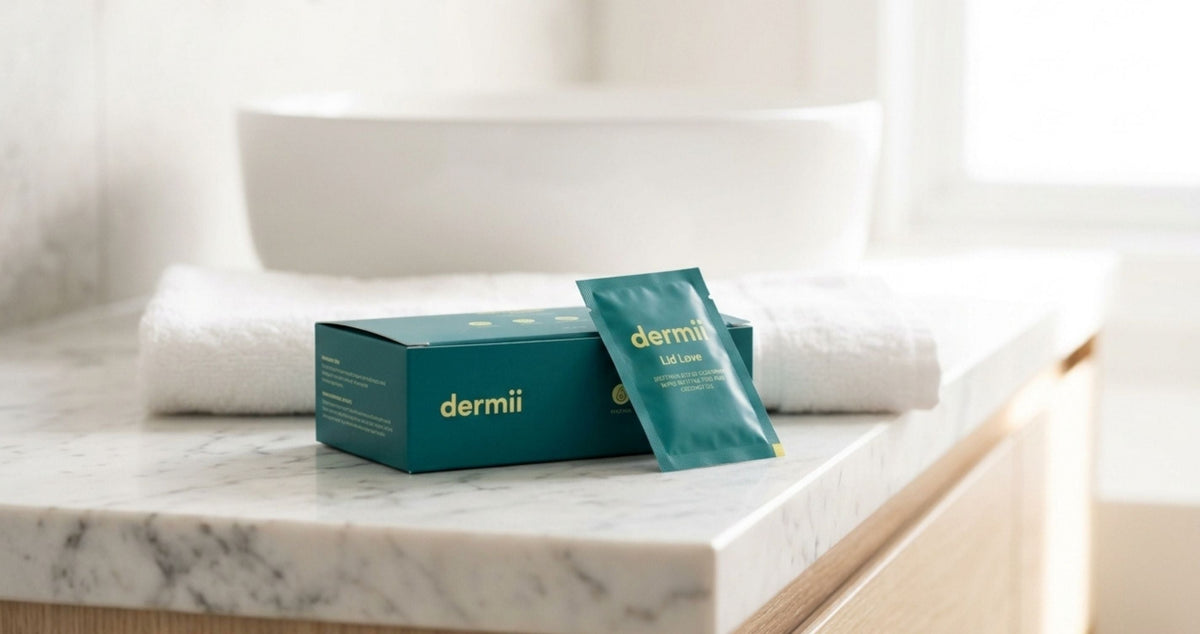
- Take a damp wipe or a clean soft cloth and hold it over your index finger. Ours are Lid Love cleansing wipes.
- Run it along the base of the upper lashes, from the inner corner outwards, using small gentle side to side movements. You are aiming at the lash line itself, not the skin above it. Then do the lower lid the same way, from inner corner outwards.
- Repeat on the other eye with a clean surface. Never reuse the same face of the cloth or wipe on the second eye.
Gentle matters more than thorough. You are lifting a film off a surface, not scrubbing. Hard rubbing irritates the margin and makes things worse rather than better.
Doing it after warmth works better than doing it cold, because softened oil moves more readily. If you are using a mask or compress in the evening, clean the margin afterwards rather than before. On warmth, and how long it needs to last.
How often should you clean your eyelids?
Daily, and twice a day if you wear eye makeup.
The evening one is the important one. That is when the day's makeup, oil and debris comes off, and it is what stops it sitting there for eight hours overnight while you are not blinking. Why your eyes are crusty in the morning.
Once you have started, keep going. This is maintenance in the same sense that brushing your teeth is maintenance. Stopping for a month puts you back roughly where you began.
Is baby shampoo safe for eyelids?
It was the standard advice for years, and there are better options now.
Diluted baby shampoo does clean. The difficulty is that it is a detergent, and a detergent works by dissolving oil. The oil sitting on your tear film is the layer you are trying to protect, so you can end up stripping the thing you are attempting to look after.
Plenty of people used it for a long time without obvious problems. It is just no longer the first thing an optometrist would reach for, because there are cleansers made for the eye area that do not act on the oil layer the same way.
If it is what you have in the cupboard tonight, it is better than doing nothing. It is not what I would have you use every night.
What about micellar water, or just a warm flannel?
| Option | What it does | The catch |
|---|---|---|
| Face wash | Cleans the surrounding skin | Almost never reaches the margin, and stings if it does |
| Diluted baby shampoo | Cleans effectively | A detergent, so it acts on the oil layer too |
| Micellar water | Lifts makeup well | Often contains alcohol and is usually rinsed off poorly near the eye |
| Warm damp flannel | Softens and wipes some debris | Reusable cloth on a lid margin is a hygiene question |
| Dedicated lid wipe | Made for the margin, single use | Cost per use |
The reusable flannel point is worth sitting with. A cloth that lives in a warm damp bathroom and gets used on your eyes every night is not the most hygienic object in the house. If you do use one, it needs to be genuinely clean each time, which in practice means a fresh one daily.
What to avoid
Rubbing. It feels good for a second and it irritates the margin. Almost everyone does it when their eyes are uncomfortable, and it reliably makes the following day worse.
Anything that stings. Discomfort is a signal. Products that sting near the eye are usually doing something you do not want them doing.
Cotton buds on the margin itself. Too firm, too easy to slip and you are close to the eye.
Scrubbing hard. More pressure does not lift more film. It just inflames a thin, sensitive edge.
Stopping after a fortnight. The most common reason people conclude lid cleaning does nothing is that they stopped before it had a chance. Oil that has thickened over years does not move in a week.
When to see an optometrist
Book a proper look if you have eye pain, sudden vision changes, light sensitivity, coloured or sticky discharge or if one eye is clearly different from the other.
Also worth booking if the margin looks red or swollen, if lashes are falling out or growing oddly, or if you have been cleaning properly for a couple of months and nothing has changed.
Frequently asked questions
How do you clean your eyelids properly? With the eye closed, run a damp wipe or clean soft cloth along the base of the lashes, top and bottom, using small gentle side to side strokes from the inner corner outwards. Use a clean surface for the second eye. It takes about twenty seconds.
Why doesn't face wash clean your eyelids? Because people wash around the eye rather than on it, since most cleansers sting. The skin of the lid gets cleaned but the margin, the narrow edge where the oil glands open, does not.
How often should you clean your eyelids? Daily, and twice a day if you wear eye makeup. The evening clean matters most, because it removes the day's makeup and debris before eight hours of not blinking overnight.
Is baby shampoo safe for cleaning eyelids? It was standard advice for a long time and it does clean. Because it is a detergent it acts on oil, including the oil layer of the tear film that you are trying to protect, so cleansers made for the eye area are now generally preferred.
Can you use micellar water on your eyelids? It lifts makeup well but often contains alcohol and tends to be rinsed off poorly so close to the eye. It is better suited to the surrounding skin than to the lid margin itself.
What should you avoid when cleaning your eyelids? Rubbing, scrubbing hard, anything that stings and cotton buds directly on the margin. Gentle matters more than thorough, since the aim is lifting a film rather than scrubbing a surface.
Keep reading
About the author: Ally is a practising optometrist in Australia and the co-founder of Dermii, an Australian lid-hygiene brand. The information in this article is general and is not a substitute for clinical advice. If you’re concerned about your eye health, please see your optometrist or GP.
Try the 30 Day Challenge
Angry, gritty, tired eyes don't need another drop. They need the layer underneath sorted out.
Do the full 30 day routine. Wipe, mist, mask. If your eyes aren't calmer and more comfortable at the end of it, tell us and you get your money back. First Bundle, one per customer.
The next cohort starts weekly from October 12th.
If your eyes are painful, your vision has changed, or redness won't settle, see an optometrist or eye care professional.