Does a warm flannel actually work for dry eyes?
By Ally Daoud, Australian Optometrist and Dermii Co-founder
The short answer
A warm flannel does not stay warm long enough to do much. A hot face washer cools to roughly room temperature within about three minutes. The oil sitting in the glands along your lid margin needs sustained warmth of around 40 degrees for fifteen to twenty minutes before it softens enough to move.
So the advice was not wrong. The tool was.
Does a warm compress work for dry eyes?
The principle works. The flannel does not.
Warmth is genuinely one of the two things that helps oil that has thickened in the glands along the edge of your eyelid. Warm it enough, for long enough, and it softens and starts moving again when you blink.
The catch is in those two words. Enough, and long enough. A face washer under a hot tap fails both within a few minutes, and almost nobody has been told that. So people do it faithfully every night for months, feel no difference, and conclude their eyes are beyond help.
Their eyes are usually fine. The flannel went cold.
How long does a warm flannel stay warm?
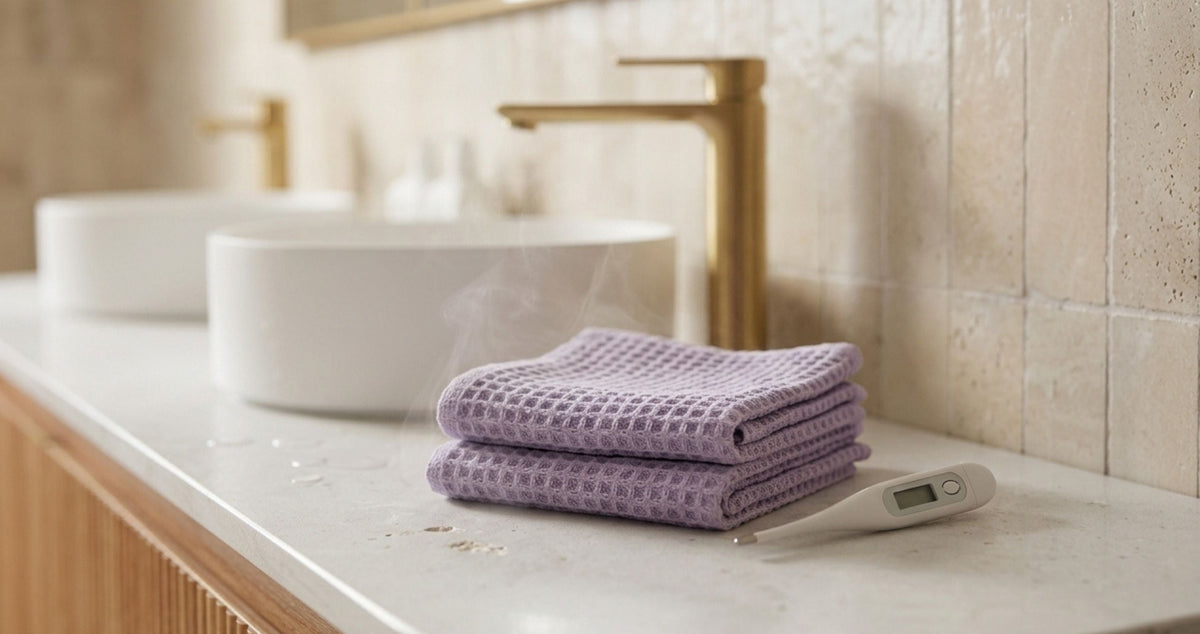
We put a kitchen thermometer on one to check.
Straight out of a hot tap, a folded face washer starts somewhere around 45 degrees. Within sixty seconds it is dropping fast. By the three minute mark it is close to room temperature and the wet cloth on your face is now actively cooling you rather than warming anything.
There is a second problem that makes it worse. Water pulls heat away from skin far faster than dry air does, so a cooling wet cloth does not just stop helping. It works against you.
Most people also take it off well before three minutes, because a cold wet flannel on your face is unpleasant. Which means the glands got perhaps ninety seconds of useful warmth.
How long does it actually need?
Around fifteen to twenty minutes of steady warmth, held at roughly 40 degrees.
That number is not arbitrary. Oil that has been sitting in a gland for years is thicker than oil that is being released daily. Think of butter straight from the fridge against butter left on the bench. Same substance, completely different behaviour. Warm it and it moves. Leave it cold and it stays exactly where it is.
Getting a gland that sits inside a lid up to temperature takes time too. You are not warming the surface of your skin, you are warming something a few millimetres beneath it. The first several minutes go into getting there. Only after that does the warmth start doing anything useful.
Which is why three minutes gets you almost nothing, and why twenty minutes gets you somewhere.
How do different heat sources compare?
| Heat source | Roughly how long it holds useful warmth | Practical problem |
|---|---|---|
| Warm face washer | About 3 minutes | Cools fast, then draws heat away |
| Reheated face washer | 3 minutes at a time | You are at the sink all evening |
| Microwaved rice or wheat bag | 10 to 15 minutes | Hard to control, can start too hot |
| Hot shower | Only while you are in it | Water rarely reaches the lid margin |
| Self-warming eye mask | About 20 minutes | Single use |
The rice bag is the closest of the household options, and plenty of people get some benefit from one. The difficulty is that it usually comes out of the microwave hotter than is safe near an eye, then passes through the useful range on its way to cold. You are guessing at both ends.
Why does warmth matter at all?
Because of what the glands are for.
Along the edge of each eyelid, at the base of the lashes, sit around thirty small glands. Each one releases a small amount of oil onto the eye every time you blink. That oil is the top layer of your tear film and its job is to stop the watery layer underneath evaporating. What your tears are actually made of.
When the oil in those glands thickens, less of it comes out per blink. The tear film gets less stable. Your eyes feel gritty, tired and dry, and no amount of water added to the surface changes it, because the water was never the problem.
Warmth softens that oil so a blink can move it again. Cleaning the lid margin gives it somewhere to go, because build-up collects over the openings. How to clean your eyelids.
One without the other does half a job.
So what should you do instead?
Three things, in order of how much they matter.
Hold the heat long enough. Whatever you use, and ours is a self-warming mask, the target is around twenty minutes at about 40 degrees, not three minutes at whatever the tap gave you. If you are using a flannel, accept that you will need to reheat it five or six times in a sitting, and do that rather than stopping after one.
Clean the lid margin daily. Warmth softens the oil. A wipe along the edge of the lid is what gives it a clear path out. Face wash goes around that strip rather than along it, so it is usually the step nobody is doing.
Do it consistently, not occasionally. This is maintenance, not a one-off. Glands that have been sluggish for years do not change in a week, and most people notice a difference somewhere between week two and week three. Mornings usually shift first.
Is a warm compress safe?
Generally yes, with two cautions.
Do not use anything hot enough to be uncomfortable. The skin on an eyelid is the thinnest on the body and it burns more easily than you would expect. Warm should feel pleasant, never sharp.
And keep your eyes closed throughout, whatever you are using.
When to see an optometrist
Book a proper look if you have eye pain, sudden vision changes, light sensitivity, coloured or sticky discharge or if one eye is clearly different from the other.
Also book one if you have been doing warm compresses properly for a couple of months with no change at all. There is more that can be assessed in a chair than at a bathroom sink, and it is worth knowing what you are actually dealing with.
Frequently asked questions
Does a warm flannel work for dry eyes? The principle works but the flannel does not hold heat long enough. A hot face washer cools to around room temperature within about three minutes, while thickened oil in the glands along the lid margin needs closer to fifteen to twenty minutes of sustained warmth at around 40 degrees.
How long should you hold a warm compress on your eyes? Around fifteen to twenty minutes. The first few minutes go into getting the glands inside the lid up to temperature, so shorter sessions achieve very little.
What temperature should a warm compress be? Around 40 degrees. Warm enough to soften thickened oil, never hot enough to feel sharp or uncomfortable, because eyelid skin is the thinnest on the body.
How often should you reheat a warm flannel? If you are using a flannel, expect to reheat it roughly every three minutes for the whole session, which is five or six times in twenty minutes.
Is a microwaved rice bag better than a flannel for dry eyes? It holds warmth longer, usually ten to fifteen minutes. The difficulty is control, since it often comes out of the microwave hotter than is safe near an eye and then cools through the useful range.
Are warm compresses safe for your eyes? Generally yes, provided the heat is comfortable rather than sharp and your eyes stay closed throughout. Eyelid skin is very thin and burns more easily than most people expect.
Keep reading
- What your tears are actually made of
- Why are my eyes worse in the afternoon?
- Three dry eye myths that need to die
About the author: Ally is a practising optometrist in Australia and the co-founder of Dermii, an Australian lid-hygiene brand. The information in this article is general and is not a substitute for clinical advice. If you’re concerned about your eye health, please see your optometrist or GP.
Try the 30 Day Challenge
Angry, gritty, tired eyes don't need another drop. They need the layer underneath sorted out.
Do the full 30 day routine. Wipe, mist, mask. If your eyes aren't calmer and more comfortable at the end of it, tell us and you get your money back. First Bundle, one per customer.
The next cohort starts weekly from 12th October.
If your eyes are painful, your vision has changed, or redness won't settle, see an optometrist or eye care professional.