How long does a lid hygiene routine take to work?
By Ally Daoud, Australian Optometrist and Dermii Co-founder
The short answer
Most people notice a difference somewhere between day fourteen and day twenty-one. The first week usually feels like nothing is happening, because oil that has thickened in the glands over years takes longer than a week to soften and start moving. Mornings tend to change before afternoons do.
That is the honest answer, and it is worth knowing before you start rather than discovering it on day eight.
How long before you feel a difference?
Two to three weeks for most people. Some notice something in the first week. Some take longer than a month.
The range is wide because the starting point is wide. Someone who has had gritty eyes for eight months is in a different position to someone who has had them for fifteen years, and the glands along the lid margin reflect that. Oil that has been sitting in a channel for a decade is thicker and less willing to move than oil that stopped flowing properly last winter. What your tears are actually made of.
A useful way to hold it: you are not taking something that acts on symptoms. You are changing the conditions at the lid margin and waiting for a system to start working again. Systems take longer than symptoms.
What happens in week one?
Usually not much, and that is expected.
You are learning where the lid margin is and how to clean it without over-doing it. You may be more aware of your eyes than usual simply because you are now paying attention to them, which some people misread as things getting worse.
Underneath that, warmth is beginning to soften oil that has not moved in a long time, and cleaning is beginning to clear the openings it comes out of. Neither produces a sensation you can feel. Both are prerequisites for anything you can.
Week one is groundwork. Nobody enjoys it.
Why does day seven feel like it isn't working?
Because day seven is roughly where the effort has added up but the result has not arrived.
You have done it every morning and every night for a week. You have paid attention to it. And your eyes feel more or less exactly as they did on day one. The natural conclusion is that this is another thing that does not work, and into the drawer it goes with the half-used bottles.
The gap between when people quit and when they would have noticed something is usually about a week. That is the single most frustrating thing about this, because the people who stop are almost never the people it was not going to help. They are the people who stopped just before.
If you take one thing from this article: day seven feeling like nothing is not evidence of anything. It is what day seven feels like. Keep going to day twenty-one and then form a view.
What changes first?
Mornings, almost always.
Waking with eyes that are less gluey, less crusted along the lash line, less like they need a minute before they work properly. It is a smaller change than people expect and it is easy to miss if you are not looking for it.
Mornings go first because they are closest to the lid margin itself. Nothing has happened to your eyes yet when you wake up, so what you feel is the state of the margin rather than the effect of the day. Change it and the morning reflects it soonest. Why your eyes are crusty in the morning.
Afternoons follow, usually a week or two behind. The 3pm grit softens rather than disappears, because your blink rate on a screen is still what it is and that part is behaviour, not build-up.
Reaching for drops less often tends to be the last thing people notice, mostly because it happens without being noticed. People often realise after the fact that the bottle has been in the drawer for a fortnight.
Write down how your eyes feel on day one. A couple of sentences. Change this slow is genuinely difficult to perceive from the inside, and people routinely underestimate how far they have come because they cannot remember the baseline.
What if you miss a day?
Carry on the next day and do not restart the count.
One missed evening does not undo a fortnight. The routine works on accumulation, and one gap in fourteen does not change the accumulation much.
What does matter is the pattern. Doing it four nights out of seven, indefinitely, is meaningfully different to doing it seven nights out of seven, and the four-night version tends to hold ground rather than gain any. If you are going to miss one, miss the morning rather than the evening. The evening clean is the one that stops material sitting on the margin overnight. How to clean your eyelids.
The all-or-nothing instinct is the real risk. People miss two days, decide they have blown it and stop entirely. That is a far worse outcome than a patchy fortnight.
Why does a hypochlorous spray sting at first?
Because it is meant for the closed lid, not the surface of the eye.
Hypochlorous acid sprays, our own Miracle Mist included, are applied to closed eyelids and left to air dry. If you open your eyes before that has happened, some gets onto the surface of the eye and it stings briefly. It is not damaging anything and it settles within seconds, but without warning it reads as the product hurting you, and people stop.
Spray onto closed lids, then keep them closed and count to thirty before opening. Most people find it fades after the first four or five uses anyway.
This is worth flagging because it is one of the most common reasons people abandon a routine in the first week, and it is entirely avoidable with thirty seconds of patience.
What if it doesn't work for you?
Sometimes it does not, and it is worth being straight about that.
Chronic eye discomfort has more than one cause. Lid hygiene addresses one of the more common ones. If you have done the full routine properly for a month and nothing has shifted at all, that is useful information rather than a failure, and it is a good reason to have someone look at your eyes properly. There may be something else going on that a routine at a bathroom sink was never going to address.
For our own 30 Day Challenge we have made that explicit. Do the full thirty days with the Lid Lover Starter Bundle and if your eyes are not calmer and more comfortable at the end of it, tell us and you get your money back. First Bundle, one per customer. We would rather you finish the thirty days and ask for a refund than quit on day seven and never find out.
Does doing it with other people help?
More than it sounds like it should.
The difficulty with a two to three week timeline is not the routine. It is ninety seconds, morning and night. The difficulty is staying with something that gives you no feedback while you are doing it.
That is why we run the Challenge as a monthly group starting on the first, rather than something you begin whenever. When day seven arrives and it feels like nothing is happening, a few hundred other people are on day seven at the same time, saying the same thing in the same place. Knowing that the flat week is normal, because you can see everyone else in it, is the difference between stopping and carrying on.
There is nothing clinical about that part. It is just easier not to quit in company.
When to see an optometrist
Book something if you have eye pain, changes to your vision, light sensitivity, or thick coloured discharge that keeps returning.
Also worth booking if you have done the routine properly for a month or two without any change, or if things have got worse rather than better. Both are worth having looked at rather than pushing through.
Frequently asked questions
How long does lid hygiene take to work? Most people notice a difference between day fourteen and day twenty-one. The first week usually feels like nothing is happening, because oil that has thickened in the glands over years takes longer than a week to soften and start moving.
Why does my lid hygiene routine feel like it isn't working after a week? Because at around day seven the effort has accumulated but the result has not arrived yet. The gap between when most people give up and when they would have noticed a change is roughly a week.
What improves first with a lid hygiene routine? Mornings, almost always. Waking with eyes that are less crusted and less gluey comes before any change to afternoon discomfort, which typically follows a week or two later.
What happens if I miss a day of my lid routine? Carry on the next day without restarting the count. One missed evening does not undo a fortnight. A consistent pattern matters more than any single day, and the evening clean is the more important of the two.
Why does a hypochlorous acid spray sting? It is designed for closed eyelids. If the eyes are opened before the spray has air dried, a little reaches the surface of the eye and stings briefly. Keeping the eyes closed for about thirty seconds after spraying avoids it.
What if a lid hygiene routine does not work for me? Chronic eye discomfort has more than one cause and lid hygiene addresses one of the more common ones. A month of the full routine with no change at all is a good reason to have your eyes looked at properly.
Keep reading
- How to clean your eyelids
- Why your eyes are crusty in the morning
- What your tears are actually made of
About the author: Ally is a practising optometrist in Australia and the co-founder of Dermii, an Australian lid-hygiene brand. The information in this article is general and is not a substitute for clinical advice. If you’re concerned about your eye health, please see your optometrist or GP.
Try the 30 Day Challenge
Angry, gritty, tired eyes don't need another drop. They need the layer underneath sorted out.
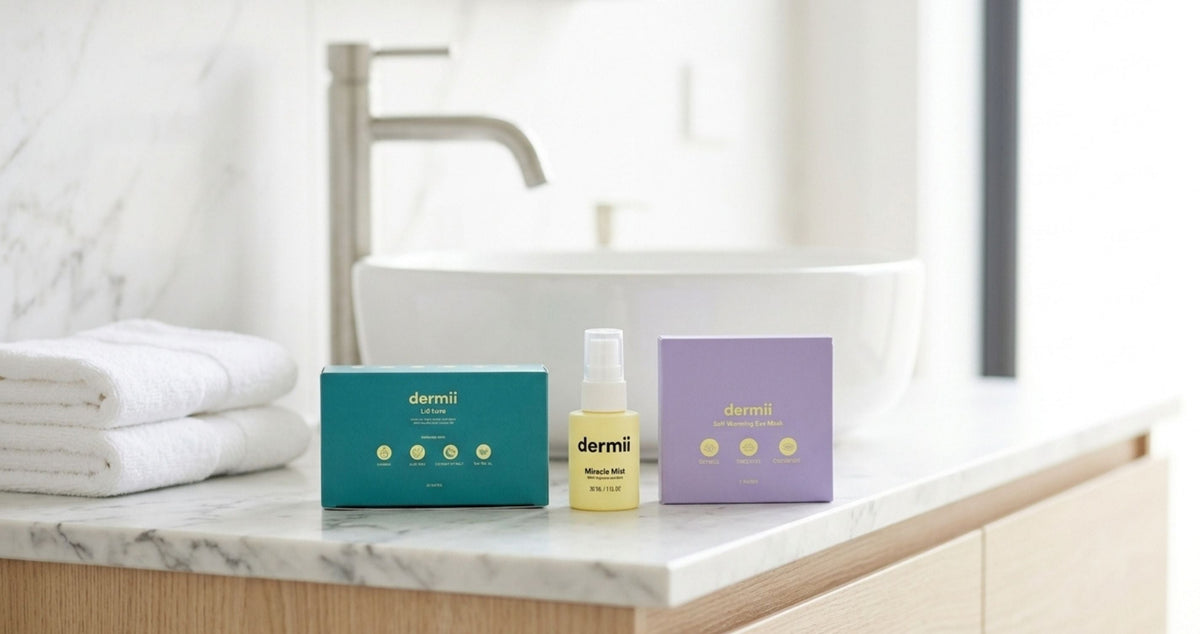
Do the full 30 day routine. Wipe, mist, mask. If your eyes aren't calmer and more comfortable at the end of it, tell us and you get your money back. First Bundle, one per customer.
The next cohort starts weekly from 12th October.
If your eyes are painful, your vision has changed, or redness won't settle, see an optometrist or eye care professional.